Airborne All The Way!
Earn your jump wings at Fort Moore, Georgia. Three weeks of ground training, tower work, and live parachute jumps that forge the Army's airborne warriors.
Scroll
Earn your jump wings at Fort Moore, Georgia. Three weeks of ground training, tower work, and live parachute jumps that forge the Army's airborne warriors.
Ground Week teaches the fundamentals of military parachuting. Students learn proper body position for exiting aircraft, the five points of contact for parachute landing falls (PLFs), and emergency procedures for malfunctions.
Physical training is intense — daily PT sessions include runs, push-ups, pull-ups, and flutter kicks. The lateral drift apparatus and suspended harness build confidence and muscle memory for actual jumps.
Students practice mock-door exits from C-130 and C-17 mockups, learning proper body position, count, and check procedures. Any failure to demonstrate safe technique results in additional training or dismissal.
Tower Week advances training to the 34-foot tower for mock-door exits and the iconic 250-foot free-drop towers. Students practice mass exits, wind drift corrections, and equipment rigging while continuing intense PT.
The 34-foot tower simulates aircraft exits with a zip-line descent, building confidence for actual jumps. The 250-foot towers — visible landmarks at Fort Moore — lift students under an open canopy and release them for a controlled descent, closely replicating the final portion of a parachute jump.
Tower Week is where many students face their fear of heights. Refusal to exit the 34-foot tower results in immediate dismissal from the course.
Jump Week is where it all comes together. Students execute five live static-line parachute jumps from C-130 or C-17 aircraft at 1,250 feet above ground level. At least one jump is conducted with full combat equipment.
Each jump builds on the last — starting with a basic "Hollywood" (no equipment) jump and progressing to full combat loads. Weather delays are common, and students may wait hours in full kit before jumping. Refusal to jump at any point means immediate dismissal.
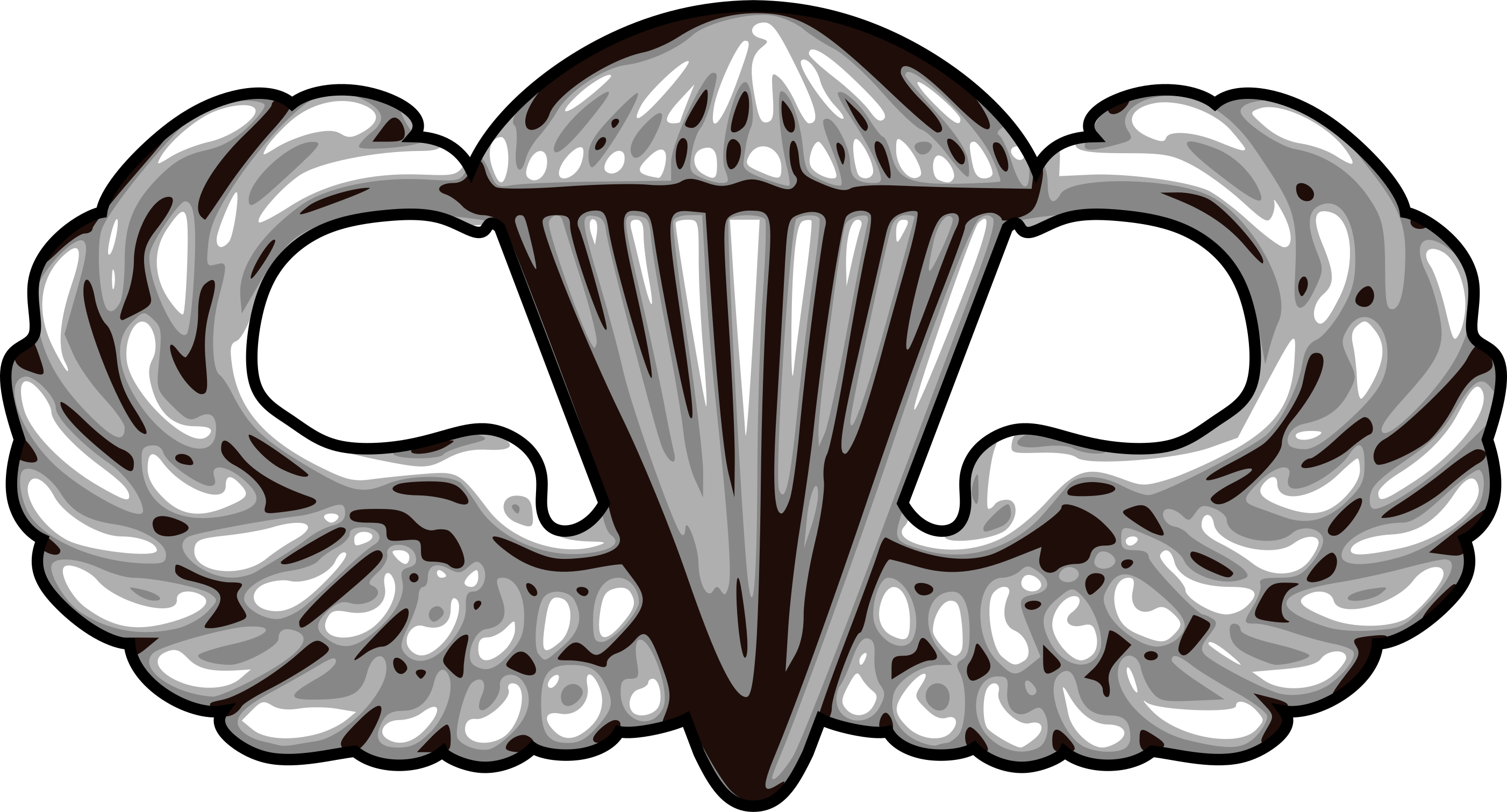
Successful completion of all five jumps earns the Basic Parachutist Badge — "jump wings" — one of the most recognized badges in the U.S. military. Graduation day is typically Friday of Week 3.
Winter at Fort Moore is mild but wet. Morning PT in 30-degree temps is a shock for students from warm climates. Jump Week wind holds are more common, potentially extending the course by days.
Spring is the best season for Airborne School. Temperatures are comfortable, rain is manageable, and jump conditions are generally favorable. Bring allergy medication — Georgia pollen is brutal.
Georgia summer is brutal. Heat index regularly exceeds 100°F. Heat casualties are the #1 non-training-related drop reason. Hydration discipline is critical — cadre enforce water consumption but you must acclimatize before arrival.
Fall is arguably the best time for Airborne School. Heat has broken, winds are generally calm, and jump conditions are excellent. The fiscal year starts in October, so the first classes are fresh with new students and full cadre energy.
BAC runs approximately every two weeks. Find your class and start preparing. Source: 1-507th Student Information.
| Class | Report Date | Graduation | Season |
|---|---|---|---|
| BAC 01-26 | 14 Oct 2025 | 31 Oct 2025 | Fall |
| BAC 02-26 | 28 Oct 2025 | 14 Nov 2025 | Fall |
| BAC 03-26 | 18 Nov 2025 | 05 Dec 2025 | Fall |
| BAC 04-26 | 02 Dec 2025 | 19 Dec 2025 | Winter |
| BAC 05-26 | 06 Jan 2026 | 23 Jan 2026 | Winter |
| BAC 06-26 | 20 Jan 2026 | 06 Feb 2026 | Winter |
| BAC 07-26 | 03 Feb 2026 | 20 Feb 2026 | Winter |
| BAC 08-26 | 24 Feb 2026 | 13 Mar 2026 | Spring |
| BAC 09-26 | 10 Mar 2026 | 27 Mar 2026 | Spring |
| BAC 10-26 | 24 Mar 2026 | 10 Apr 2026 | Spring |
| BAC 11-26 | 07 Apr 2026 | 24 Apr 2026 | Spring |
| BAC 12-26 | 28 Apr 2026 | 15 May 2026 | Spring |
| BAC 13-26 | 12 May 2026 | 29 May 2026 | Spring |
| BAC 14-26 | 02 Jun 2026 | 19 Jun 2026 | Summer |
| BAC 15-26 | 16 Jun 2026 | 02 Jul 2026 | Summer |
| BAC 16-26 | 07 Jul 2026 | 24 Jul 2026 | Summer |
| BAC 17-26 | 21 Jul 2026 | 07 Aug 2026 | Summer |
| BAC 18-26 | 04 Aug 2026 | 21 Aug 2026 | Summer |
| BAC 19-26 | 18 Aug 2026 | 04 Sep 2026 | Summer |
| BAC 20-26 | 08 Sep 2026 | 25 Sep 2026 | Fall |
| BAC 21-26 | 22 Sep 2026 | 09 Oct 2026 | Fall |
The physical standards are absolute. The mental challenge of stepping out of a perfectly good aircraft is the real test.
Every failure at Airborne School has a type. We built a fix for each one.
Parachute landing falls are everything. Master the five points of contact before you arrive or risk injury and dismissal.
The 34-foot tower separates the willing from the unwilling. Mental prep and exposure training starts here.
Pull-ups, push-ups, and the 2-mile run are daily. Show up physically ready or get recycled in Ground Week.
Packing list compliance is non-negotiable. Our Airborne gear shop has every item on the list.
A poor aircraft exit means a bad canopy. Learn the door procedures cold before you set foot on the bird.
Georgia heat is brutal. Hydration plans and heat acclimatization protocols keep you in the fight.
Key Takeaway: Physical fitness and following instructions are everything. Airborne School has one of the highest pass rates in the Army — if you show up in shape and do exactly what you're told, you will earn your wings.
I am the American Paratrooper. I am a guardian of freedom and the American way of life.
I am my country's best. I am trained and ready to fight, and if necessary, to die in defense of my people and the United States of America. I was born to lead, and I follow no one, for the road I take, others will follow.
I am a Paratrooper, an elite soldier. I am a static-line, combat-jump qualified Paratrooper. I volunteer to be part of the greatest fighting force the world has ever known — America's All-American Airborne.
I shall never fail my fellow paratroopers, for they depend on me as I depend on them — in battle and in peacetime. Together we are a team ready to be called by our Nation at a moment's notice.
I shall never bring dishonor to my unit, the Airborne, the Army, or my country. I am a Paratrooper, and I have the discipline and courage required of me by my role as a combat-ready soldier.
I am a soldier of America's Army, and proudly I will be — Airborne All The Way!
Class dates, gear drops, new courses, and tips from jump-qualified soldiers — straight to your inbox. No spam. Unsubscribe anytime.